

NEW: Vacant and/or blighted building exemption eligibility provisions were recently changed under a new law, effective on or after October 1, 2025. More details are in this Vacant and/or Blighted Building Exemption Flyer.

Vacant and Blighted Properties
The DC Department of Building’s (DOB) goal is to bring vacant and blighted properties back into productive use. DOB responds to public complaints about such properties and enforces requirements for property owners to protect the public’s health, safety, and welfare.
Key Points to Know
- Report a vacant or blighted property below:
Report Vacant/Blighted Property
- If you believe your property is occupied: Request an Occupancy Inspection.
- All vacant and blighted properties must be registered.
- Vacant and blighted properties can qualify for an exemption from higher property taxes if they meet certain criteria.
- Blighted properties are only eligible for exemptions from Fiscal Year 26 forward (after October 1, 2025).
- If you plan to bring a property back to productive use:
- If this is a commercial property (or something other than a single-family dwelling), make sure you have a valid Certificate of Occupancy (C of O).
- Apply and pay for construction permits online:
- Use the Citizen Access Portal for commercial projects, solar, demolition, razes, and after-hours permits.
- Use the DOB Permit Wizard for one and two-family residential projects.
- If the property is currently undergoing construction or renovations, find building permits, applications, invoices, plans, or C of O permits in eRecords.
- A commercial building may qualify for a Pop Up Permit (PUP) if it meets certain conditions and can be occupied by a business without substantial repairs or renovation.
Details on vacant or blighted property definitions, and registration and exemption rules, are below.
What Is a Vacant Property?
Simply put, a vacant property has not been occupied continuously. Some factors to consider are whether:
- Electrical, gas, or water meter are not running or showing low usage
- Mail has accumulated
- Neighbors complained
- No window covering
- No furniture observed
- Open accessibility
- Deferred maintenance, including loose or falling gutters, severe paint chipping, or overgrown grass
- Boarded up dwelling
See DC Official Code § 42–3131.05 (5))
What Is a Blighted Vacant Property?
A blighted vacant property is unsafe, insanitary or otherwise threatens the community’s health, safety, or general welfare. Factors to consider include:
- It is under a condemnation proceeding before the Board of Condemnation and Insanitary Buildings (BCIB);
- It is boarded up; and/or
- It fails to comply with these vacant building maintenance standards:
- Doors, windows, areaways, and other openings are weather-tight and secured against entry by birds, vermin, and trespassers.
- Missing or broken doors, windows, and other openings are covered.
- The exterior walls are free of holes, breaks, graffiti, and loose or rotting materials.
- Exposed metal and wood surfaces are protected from the elements and against decay or rust by periodic application of weather-coating materials, such as paint.
- Structures such as balconies, porches, canopies, marquees, signs, metal awnings, and stairways are safe and sound, and exposed metal and wood surfaces are protected from the elements by weather-coating materials such as paint
Appealing a Blight Designation
If you are seeking to appeal a blighted determination, please download, complete, and send the Blight Building Response Form and Appeal Checklist to [email protected].
All Vacant and Blighted Properties Must Be Registered
Vacant and blighted unoccupied properties for 90 days or more must be registered. (See District of Columbia Title 42. Real Property.)
- Failure to register may result in fines of $1,000, $2,500, and $5,000 each year for each offense, as well as increased property taxes.
- Even if you don’t register voluntarily, DOB may classify your property as vacant or blighted and your tax bill will increase.
Vacant Property Registration
- Create an AccessDC account to use the Citizen Access Portal.
- Register with Vacant Building Enforcement.
- Select Online application.
- Click Building20 arrow and select “Vacant Property Registration.”
- Fill out the required information and select Vacant in Step 2.
- Pay the registration fee via our online payment portal.
Blighted Property Registration
- Fill Out the Blight Building Response Form and Appeal Checklist.
- Pay the registration fee via the online payment portal.
Vacant and Blighted Property Exemption from Higher Taxes
Occupied properties have classifications for property tax purposes of Class 1 (residential) or Class 2 (commercial). However, vacant and blighted properties are subject to higher tax rates to encourage owners to return properties to productive use:
- Vacant properties: Class 3 rate of 5%
- Blighted properties: Class 4 rate of 10%
These rates are billed twice a year by the Office of Tax and Revenue. The tax year runs from October 1, with one bill covering October to March and another covering April to September.
Getting an Exemption
In specific cases, vacant properties may be eligible for a limited exemption from higher tax rates. The exemption period can range from a half- tax year, up to two tax years, depending on the category. Exemptions are reviewed annually, can be withdrawn at any time, and cannot exceed five years in any 12-year period.
NOTE: Blighted properties are only eligible for exemptions from Fiscal Year 26 forward (after October 1, 2025).
Exemption Categories
The exemption categories below require substantial documentation and evidence:
- The property is under active construction: Permit numbers within the last 12 months will be required.
- The owner is actively seeking to sell or rent the property: Listing documentation will be required.
- Probate proceedings or litigation: Documents such as the deed and court documents will be required.
- The property is subject of a pending application before a DC development board: A copy of the application will be required. (Boards include Board of Zoning Adjustment, Zoning Commission, Commission on Fine Arts, Historic Preservation Review Board, Mayor's Agent for History Preservation, the Department of Public Works, or National Capital Planning Commission.)
- Substantial economic or personal hardship: Includes, but is not limited to individual bankruptcy; significant medical events; unemployment due to involuntary termination; impact of natural disaster or fire (not involving criminal activity or negligence); individuals age 60 older receiving social security disability insurance, or age 65 or older with a median family income of no more than 120% who have experienced medical, personal, or financial hardship in the past 180 days.
How to Apply
Complete the Vacant and/or Blighted Building Response Form and email it to [email protected], or use the Citizen Access Portal below:
If you are using the Substantial Economic or Personal Hardship exemption, you also need to complete Substantial Economic or Personal Hardship Attachment A and Attachment B. If your exemption is denied, you can appeal using the Vacant Building Exemption Denial Appeal Form.
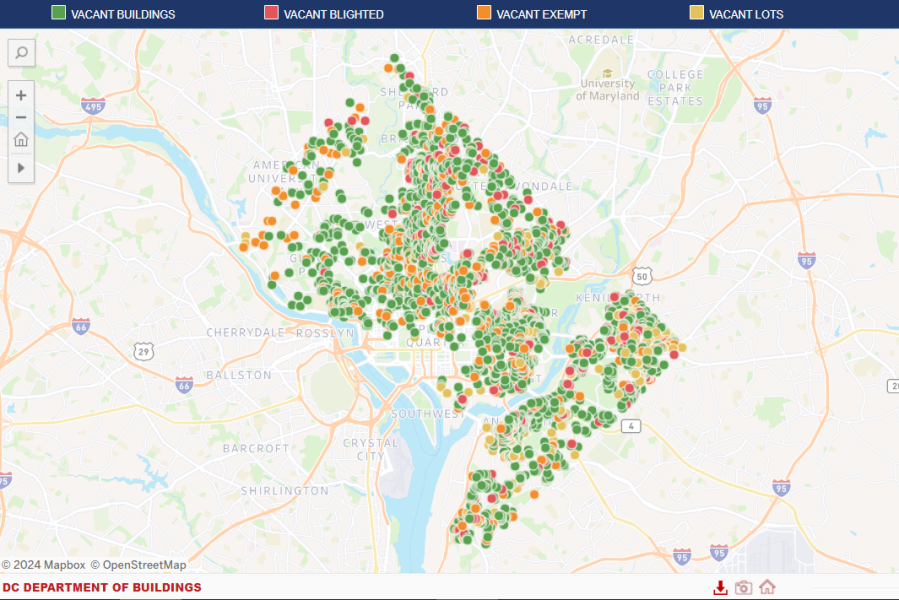
Vacant and Blighted Property Map
Curious about the status of your residential property and if it has been deemed vacant or blighted? Check out DOB's Vacant Property section of its Public Dashboard:
Resources
- Vacant and/or Blighted Building Response Form
- Vacant Building Exemption Denial Appeal Form
- Substantial Economic or Personal Hardship Attachment A
- Substantial Economic or Personal Hardship Attachment B
- Vacant and/or Blighted Building Exemption Flyer
- Blighted Building Response Form and Appeal Checklist